GBase Chat | Discussing Financial Disaster Recovery Solutions (Part 2)
Regarding disaster recovery solutions for the financial industry, in the previous article【GBASE Talks | Financial Disaster Recovery Solutions (Part 1)】we discussed storage security and service security in redundancy. In this article, let’s discuss how transmission security is achieved?
Transmission Security - No Interruptions
Transmission interruptions mainly arise from two causes: network outages or physical data center damage. In such cases, what we need is system-level redundancy, namely a dual-center disaster recovery configuration.
Transaction Processing Engine:
For the transaction processing engine, GBase 8s provides local short-distance replication and remote asynchronous replication technologies to deliver disaster recovery solutions for system-level failures.
We refer to the local short-distance replication solution as the HAC replication solution.
Basic principles of HAC operation: When the primary database server begins flushing the contents of the logical log buffer in shared memory to the logical log on disk, the database server also copies the contents of the logical log buffer to the data replication buffer on the primary database server. The primary database server then sends these logical log records to the HAC secondary database server.
The HAC secondary database server receives logical log records from the primary database server into the shared memory receive buffer (the database server automatically adjusts the receive buffer to an appropriate size for the volume of data being sent). The secondary database server then applies the logical log records during logical recovery and applies these records to its own database space.
HAC data replication supports both synchronous and asynchronous modes.
Synchronous update mode: Once the primary database server writes the logical log buffer contents to the HAC buffer, it sends those records from the buffer to the HAC secondary database server. The logical log buffer on the primary database server is flushed only after the primary database server receives acknowledgment from the HAC secondary database server that the records have been received. With synchronous updates, if a failure occurs, transactions committed on the primary database server will not remain uncommitted or partially committed on the HAC secondary database server.
Asynchronous update mode: The primary database server flushes the logical log buffer after copying its contents to the HAC buffer. (This is independent of the preceding operation.) The primary database server sends the contents of the HAC buffer across the network when either of the following conditions occurs:
• The HAC buffer becomes full.
• The time interval specified by the configuration parameter on the primary database server has elapsed since records were last sent to the secondary database server.
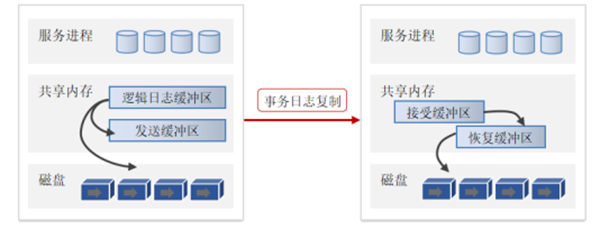
Diagram of a domestically developed OA system deployment for a leading insurance company
HAC deployment enabled the initial adaptation of certain key domestic products. Adaptation of TongTECH middleware with the GBASE GBase database; adaptation of the OA system with the GBASE GBase database for the insurance industry.
We refer to the remote geo-redundant replication solution as the RHAC replication solution.
RHAC is similar to HAC in many ways. The method of sending logs to RHAC secondary nodes is very similar to the way the primary server sends logs to HAC secondary servers. However, RHAC uses the SMX asynchronous communication framework, thereby minimizing its impact on the primary server. For this reason, transaction commits or checkpoints between the primary server and RHAC secondary servers are performed asynchronously. By being promoted to an HAC secondary server and ultimately to a primary server, RHAC takes over the remote primary server and delivers remote service takeover.
A certain scheduling cloud platform uses RHAC to implement a disaster recovery configuration spanning 1600 kilometers:
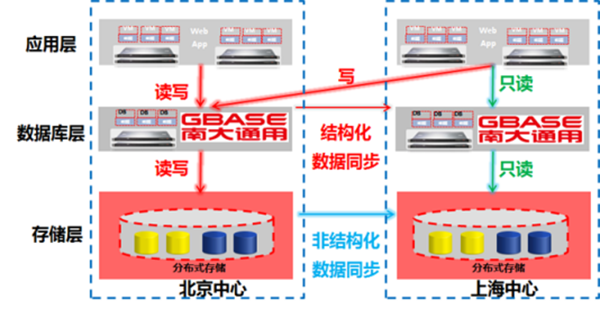
Through the deployment of a remote geo-redundant disaster recovery solution spanning thousands of kilometers, a local and remote read/write separation active-active cluster achieves second-level data synchronization. Since the product went live, it has fully exceeded customer expectations in stability, high performance, and high availability for supporting core business operations, providing a demonstration and reference for remote geo-redundant active-active domestic IT innovation deployment.
Analytical Processing Engine:
For the analytical processing engine, GBase 8a provides multi-cluster replication technology to deliver geo-redundant disaster recovery solutions.
Here is an example of the only production deployment in the financial industry of a highly available MPP database active-active cluster built with GBase 8a, configured as shown below:
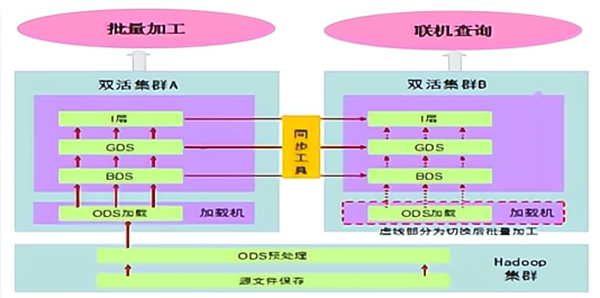
• Query and batch processing separation design:
1、Business-wise, queries and batch processing run in parallel, with the two clusters not affecting each other;
2、Cluster A handles batch processing, while Cluster B performs online queries.
• Synchronization solution design:
1、Consistency solution design based on inter-cluster synchronization tools;
2、Real-time consistency solution design based on mirrored clusters.
By deploying a highly available MPP database active-active cluster, data queries are separated from batch processing, improving data processing and data service capabilities. By supporting incremental data synchronization, near-real-time synchronization, and file block synchronization, business continuity is improved during system upgrades, disaster recovery, and exception handling.
Summary
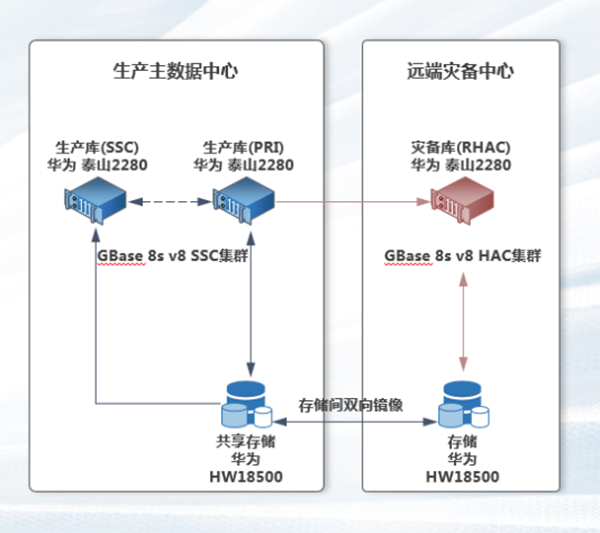
Comprehensive disaster recovery solutions for the transaction engine are provided through disk protection, service delivery protection, and protection against catastrophic transmission interruptions. Taking GBase 8s as an example, its logical configuration is shown below:
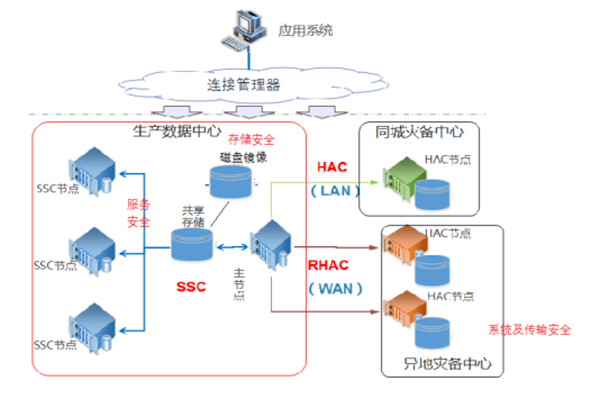
The following is a configuration practice of a city commercial bank:
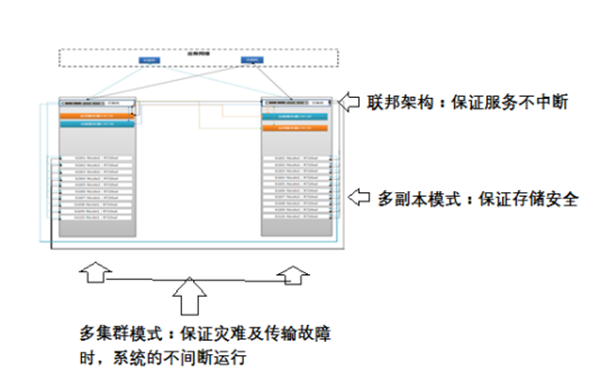
For the analytical engine, protection is provided through multiple replicas, pooled management nodes, and multi-cluster synchronization. Taking GBase 8a as an example, its logical configuration is shown below:
The following diagram shows the Beijing-Changsha dual-center configuration practice of a fund clearing center that provides fund clearing services, including remittances, bank drafts, and interbank deposit and withdrawal services for personal accounts, to 30 rural cooperative financial institutions nationwide and their tens of thousands of branches:
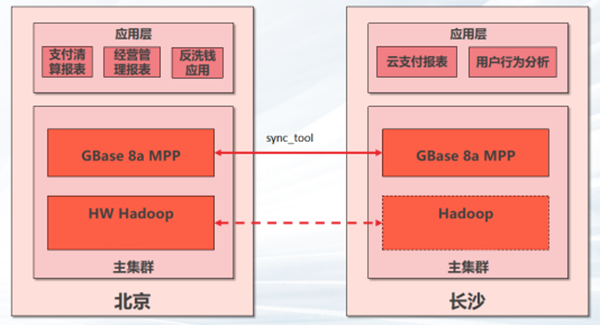
GBase 8a multi-cluster support capabilities ensure data synchronization between the two centers.
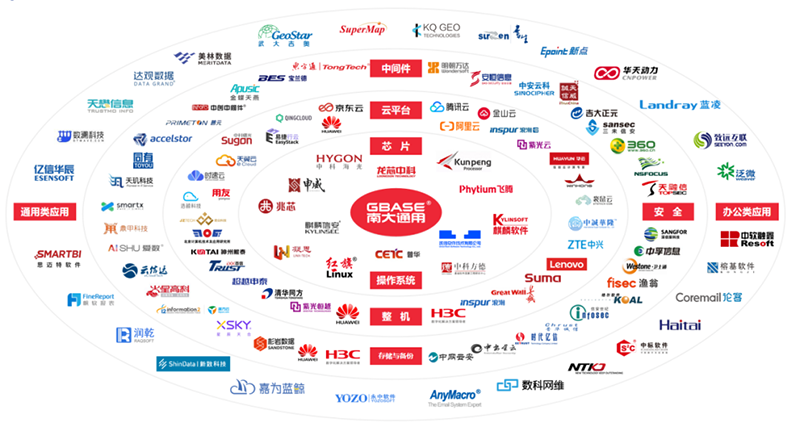
Since its establishment in 2004, Tianjin General Data Technology Co., Ltd. (GBASE) has used data security as the benchmark for product development. Its first database product was named “Secure Database.” Through nearly 20 years of effort, it has focused on domestic database development, with all core products adapted to the domestic ecosystem, covering nearly all domestic general-purpose platforms:
With comprehensive data protection and diversified disaster recovery solutions, GBASE provides customers with flexible disaster recovery system deployment solutions. Trusted by customers, it now serves users in more than 30 countries and regions and 32 provinces in China, with over 30000 running nodes and total data volume >300PB.
Our pursuit of disaster recovery goes beyond second-level RTO; our goal is zero interruption!