PICC Property and Casualty Data Platform Replacement Project with Independently Developed Technology
PICC P&C Data Platform Domestic Replacement Project
1 Project Overview
Project Background
The original PICC data platform was built on the TD appliance platform, with tightly coupled hardware and software, resulting in high usage and maintenance costs. Storage capacity and processing performance have now reached bottlenecks, vertical scaling is not possible, and expansion requires business interruption.
This project aims to reconstruct the system by adopting an MPP database product. Through a massively parallel processing architecture and an open X86 hardware platform, it will build a big data platform with distributed computing and linear horizontal scalability. Independent platforms will be built according to different application scenarios to achieve platform isolation and avoid resource contention. This will address the insufficient storage resources and computing performance of the current data platform of PICC Property and Casualty Company Limited.
Issues of Concern
The customer urgently needs to address the following issues:
The ACRM system runs on both Oracle and the TD appliance, with complex data flows and a high degree of system dependency;
Current storage capacity and processing performance have reached bottlenecks, and vertical scaling is not possible;
Daily reports are updated at the earliest on T+2, which cannot meet current business requirements;
Monthly reports for recent months could not be released until the 15th, and were sometimes delayed until the 20th;
The segmentation tool is updated once a week, with each update requiring more than 3 days to run.
The customer hopes to build an independent big data platform with distributed computing and linear horizontal scalability to solve the various issues currently facing the data platform.
Implementation Requirements
In the future, PICC Property and Casualty Company Limited will establish a data service platform where TD appliances and MPP databases coexist.
Some functions of the business analysis platform, auto insurance analysis, claims analysis, and other systems running on TD can be migrated to the MPP database to reduce the load on the appliance.
Use the MPP database to build a big data resource center, promote the integration and sharing of data resources, and enhance data asset operations and management capabilities.
Migrate the data analysis systems currently running on Oracle and Informix systems to the MPP database, significantly reducing costs while improving system efficiency and providing better data services for the business analysis and business development of PICC Property and Casualty Company Limited.
31.2 Solution
Based on PICC's characteristics and implementation plan, a big data resource center was built using the GBase 8a cluster. The technical features of the GBase 8a cluster, including columnar storage, intelligent indexing, linear scalability, and distributed parallel computing, support users' business development needs and address the performance bottlenecks and lack of linear scalability faced by TD appliances and Oracle. This achieves unified integration, unified management, and unified scheduling of data analysis, laying a solid foundation for PICC to achieve its new goals.
Use the GBase 8a cluster database to build a big data resource center, promote the integration and sharing of data resources, and enhance data asset operations and management capabilities. The overall system architecture is as follows:
PICC Data Platform Architecture Diagram
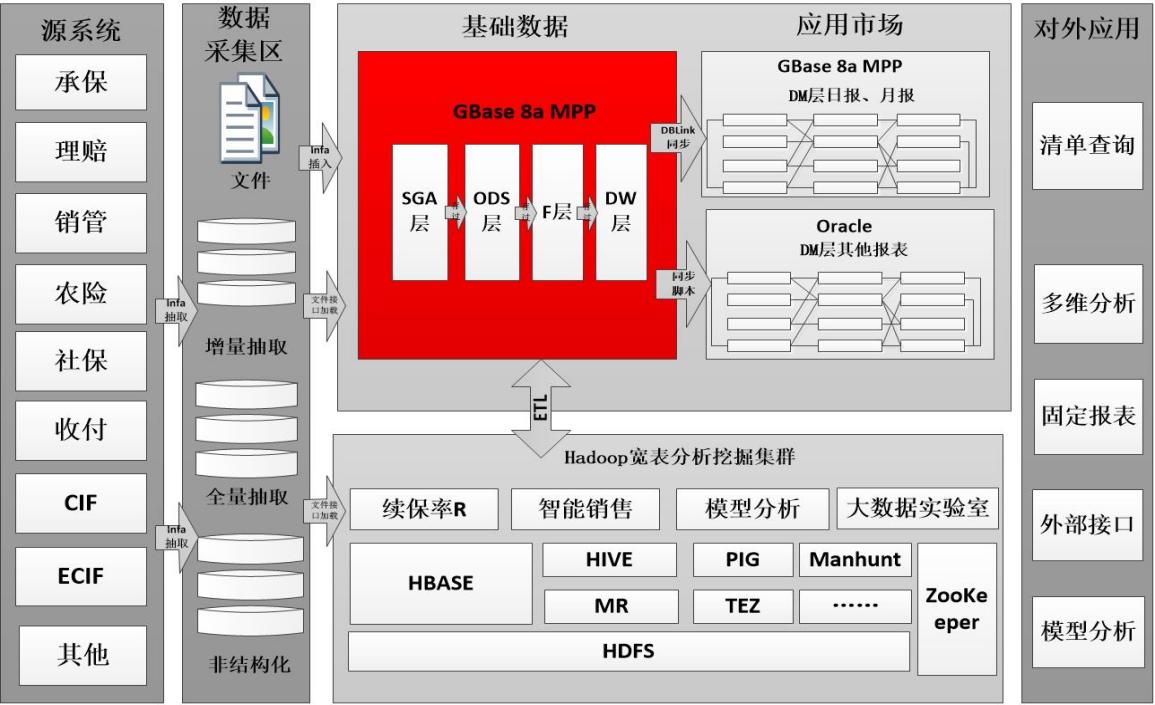 |
The data analysis systems running on Oracle and TD systems were migrated to the MPP database, significantly reducing costs while improving system efficiency and providing better data services for PICC's business analysis and business development.
Build a big data lake platform based on GBase8a MPP Cluster and connect data from upstream business systems; gradually separate main data warehouse operations, starting with data marts to gradually reduce the TD main data warehouse workload, separate core operations, and move from parallel operation to gradual migration and replacement.
3 Application Results
Implementation Status
PICC has completed the installation and deployment of more than 100 production cluster nodes, with the overall data volume reaching the PB level. After replacing the original Oracle database, overall performance improved by 2~10 times, and the migration of more than 1,000 programs was completed.
Benefits and Value
High Performance: Intelligent indexing and a fully parallel architecture support ultra-fast query and analysis, comprehensively supporting high-performance query and analysis scenarios. The ACRM system database was migrated from Oracle + IBM P780 servers to GBase 8a cluster + X86 servers. With a hardware configuration ratio close to 1:1, performance improved by more than 2-10 times;
Scalable: An open architecture enables on-demand horizontal scaling: the Shared-Nothing architecture supports online on-demand expansion without business interruption;
Highly Reliable: HA across all components, with no single-node failure: a federated architecture with an all-HA design for components including cluster management nodes and data nodes; supports active-active clusters to comprehensively ensure system availability;
Easy to Manage: One-click node replacement: provides streamlined handling of node hardware failures; inter-cluster tool DBLink: enables mutual data access between two clusters; cluster management and monitoring tools enable centralized, graphical operations for multiple clusters.
Vendor Services: The vendor provides PICC with solutions and expert support services for TD data warehouse migration and Oracle migration.